In this article a new approach is outlined for the effective management of public sector sourcing. This approach uses Sourcing Portfolio Analysis and Power Positioning techniques to develop a sophisticated understanding of how to improve ‘value for money’ in public procurement.
In doing so this new approach — Right Sizing — builds on traditional thinking about how to improve public procurement using ‘cost reduction’ techniques based primarily on the aggregation of ‘categories of spend’ and the award of longer-term framework deals with preferred suppliers.
There are two broad choices facing governments when they seek to improve public sector sourcing. The currently dominant thinking used by most governments can be summarised as tactical spend management. In this White Paper the strengths and weaknesses of this orthodox aggregation approach — based on standardisation, aggregation, supply base reduction and volume leverage — are briefly summarised, and compared with a more radical approach based on the adoption of value flow management thinking.
This more radical approach uses Power Positioning and Sourcing Portfolio Analysis tools and techniques to identify the scope for improved ‘value for money’ from strategic supply management. A case study is presented of how this way of thinking has recently transformed public procurement in the UK to deliver improved ‘value for money’, as well as significant reductions in costs when compared with more traditional approaches based on tactical spend management.
1. The Current Aggregation Orthodoxy in Public Procurement Practice
In UK government a new Crown Commercial Service (CCS) was established in the autumn of 2013. Its remit was to deliver cost savings by ensuring that government acts as a true single customer. To this end the CCS will:
- Centrally manage the purchase of common goods and services (such as professional services and energy).
- Introduce a new Complex Transactions Team to work with departments on complex procurements, reducing the need for external advice.
- Enable departments to focus their commercial efforts on their own strategic requirements.
- Further strengthen the commercial leadership within government.
- Further strengthen the procurement profession and improve overall commercial ability across the Civil Service.
- Continue to work closely with the wider public sector to ensure that the benefits of aggregation and centralisation are shared across the public sector to maximise savings for the taxpayer.
This thinking is based on tactical spend management thinking and focuses primarily on the use of aggregation as the basis for improve leverage and reducing costs in public sector sourcing. This traditional approach to leverage can be summarised as follows:
- Standardise all supply requirements and aggregate all similar items into the same ‘category of spend’
- Use supply market analysis to identify a limited number of pre-defined preferred suppliers for market test
- Use market competition to identify the lowest cost supplier, or suppliers
- Reduce the costs of supply by using volume leverage to aggregate spend with one, or if this is not feasible, the fewest number of suppliers possible
- Enhance cost leverage during negotiations, and reduce post-contractual transaction costs, by awarding medium to long-term framework agreements with preferred suppliers
This is perhaps the most commonly used strategy by procurement professionals when seeking to reduce costs quickly. Unfortunately, while it can often generate considerable short-term reductions in cost, it can also create a number of problems for users and may not always be the most effective approach to reduce costs for some ‘categories of supply’. These problems arise because this strategy mistakenly assumes that ‘cost reduction’ rather than ‘value for money’ is the primary goal of public procurement, and that aggregation and supply base reduction are always the best means available for reducing the costs of supply. As we shall see in what follows, this thinking is based on an outdated approach to sourcing options identification and selection in public sector sourcing.
2. Right Sizing — Buying the Right Stuff at the Right Price
One of the most challenging areas for government sourcing is IT, where there has been considerable evidence of procurement failure. These failures have been recorded within many areas of the public service, although they have been extensively documented in Health and Defence-related contracting in particular. The failure to achieve valued outcomes from IT contracting has normally involved a failure by suppliers to deliver the functionality required and/or within the originally agreed budget — resulting in extensive cost overruns for sub-optimal IT systems and processes.
Given this it is interesting to note that, until recently, CCS thinking about how to improve IT sourcing has focused almost exclusively on the orthodox standardisation, aggregation, supply base reduction and volume leverage approach briefly outlined above. This means forcing requirements whenever possible into a standard specification and then seeking to reduce costs by leveraging aggregated volumes with one, or only a few suppliers.
The consequence of this has been the award of a number of framework agreements with preferred IT suppliers in order to reduce costs. For example, CCS has a framework for the buying managed email, and in the past there had been talks with Blackberry and Nokia about four year bulk deals for the supply of mobile phones. Similarly, Consultancy One is a four year framework with a fixed number of suppliers that provides for lower cost agreed day rates, but limits the choice of consultants that can be used for any particular requirement.
The problem with this current approach to public sector IT sourcing is that there is considerable evidence that this orthodoxy is resulting in poor ‘value for money’ in sourcing decisions. Interestingly, there is evidence that this approach has been in tension with the IT strategy administered by the Office of the Chief Technology Officer, where disaggregation and getting full value from SMEs has been the primary strategy.
As Figure 1 demonstrates this tension between cost reduction and value delivery can be shown as a series of choices. Buyers can either source the ‘Right Stuff’ (i.e. what the customer needs and values) or the ‘Wrong Stuff’ (i.e. what the customer does not need and does not value). Relatedly, a buyer can source at the ‘Right Price’ (i.e. at the lowest cost possible) or at the ‘Wrong Price’ (i.e. at a premium price).
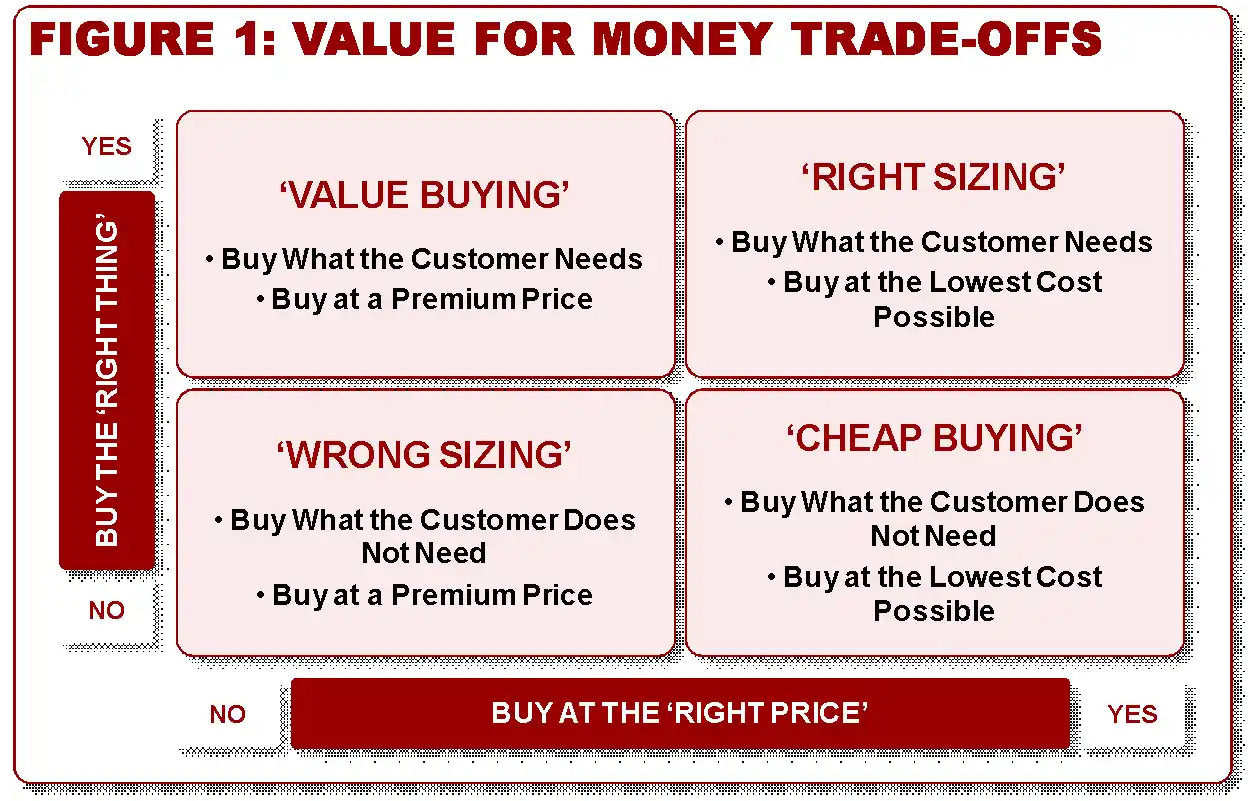
Figure 1: Value for money trade-offs
A two-by-two matrix. The vertical axis is ‘Buy the ‘right thing’’, with Yes at the top and No at the bottom. The horizontal axis is ‘Buy at the ‘right price’’, with No on the left and Yes on the right.
- Top left, ‘Value Buying’: Buy what the customer needs; Buy at a premium price
- Top right, ‘Right Sizing’: Buy what the customer needs; Buy at the lowest cost possible
- Bottom left, ‘Wrong Sizing’: Buy what the customer does not need; Buy at a premium price
- Bottom right, ‘Cheap Buying’: Buy what the customer does not need; Buy at the lowest cost possible
This results in a segmentation of sourcing decision-making in which the following outcomes can occur:
- Right Sizing — Buying what the customer needs/at the lowest cost possible
- Value Buying — Buying what the customer needs/at a premium price
- Wrong Sizing — Buying what the customer does not need/at the lowest cost possible
- Cheap Buying — Buying what the customer does not need/at a premium price
It is self-evident that to obtain ‘value for money’ buyers must pursue Right Sizing — obtaining what the customer needs and at the lowest cost possible. This is different to Cheap Buying, which uses cost reduction as the primary basis for making sourcing decisions, irrespective of whether the customer is supplied with what they actually need to fulfil their tasks successfully. Clearly, what should be sourced cannot be determined solely by what it costs, but rather must be understood as a trade-off between what is required functionally from any supply item, in relation to its relative costs of its acquisition.
Unfortunately, the inability of buyers to understand this trade-off is not new because, as John Ruskin indicated many years ago:
“There is scarcely anything in the world that some man cannot make a little worse, and sell a little more cheaply. The person who buys on price alone is this man’s lawful prey.”
Similarly, as Oscar Wilde also bemoaned in earlier times:
“Nowadays people know the price of everything and the value of nothing.”
It is, therefore, a great pity that so much of current thinking in public procurement still fails to understand these simple rules of thumb when thinking about value in sourcing decision-making. Two simple examples from recent public sector sourcing decision-making are presented below to reinforce the point that knowing the ‘cost’ of something does not tell us anything about its ‘value’.
A. Sourcing Mobile Phones
Some years ago a decision was taken in the UK public sector to explore the scope to standardise the specification of mobile phones, and focus on either Blackberry or Nokia products. The thinking at that time was that if all mobile phone requirements could be aggregated into one specification then volume leverage would be feasible, and a substantial discount could be negotiated from the full cost price. And especially if a four-year framework agreement was entered into for all future mobile phone requirements.
There is nothing wrong with the assumption that, by standardising, aggregating and identifying one or two preferred suppliers, volume leverage will normally lead to a reduction in the full premium price that a one-off or small volume purchaser would receive. The problem, however, is that this thinking is only focused on the cost side of the ‘value for money’ equation.
If such a decision to enter into a medium-term framework agreement with Nokia and/or Blackberry had been made it is now clear that this would have provided civil servants with outdated technology and limited functionality, that would have seriously undermined their personal productivity. This is because advances in technology have resulted in the development of smart phones, with Google applications. These i-phones and androids provide much greater flexibility and productivity than the old technologies, which are locked into Windows XP, with slow booting capabilities and without collaborative apps or Google hangout.
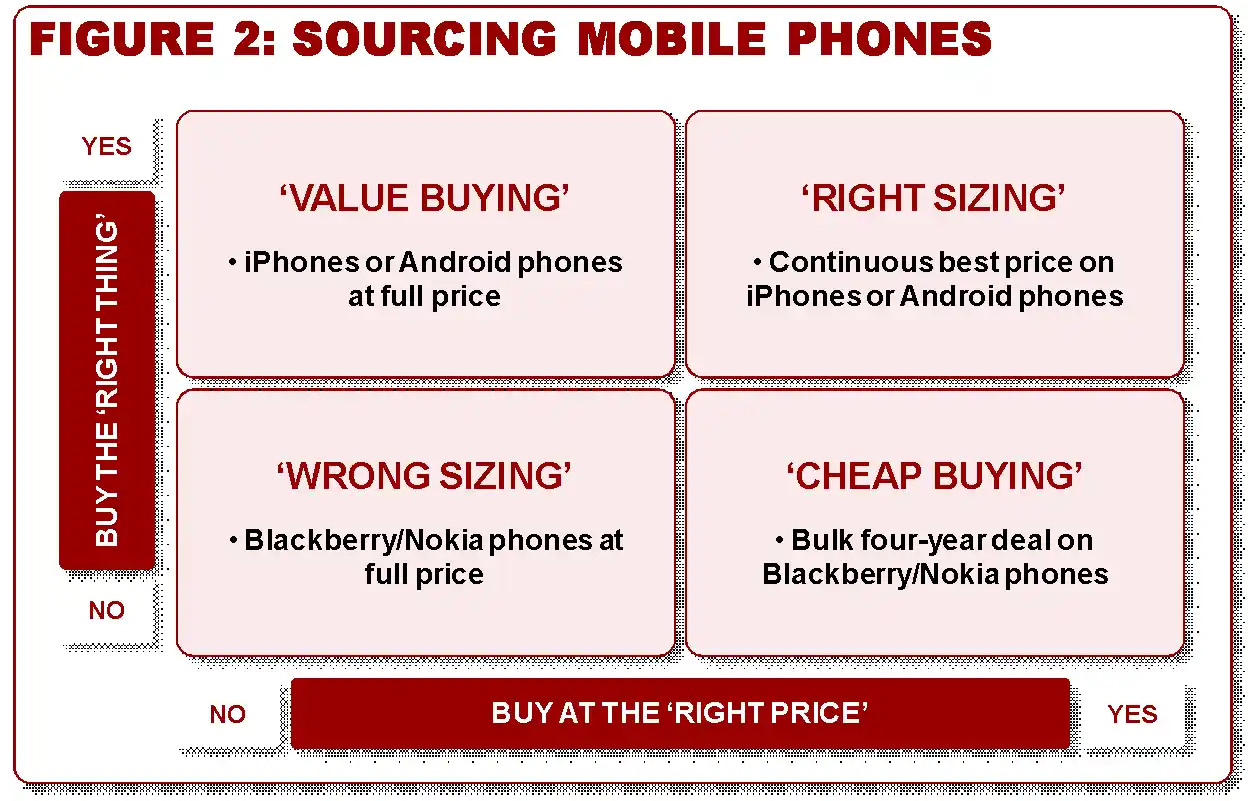
Figure 2: Sourcing mobile phones
A two-by-two matrix. The vertical axis is ‘Buy the ‘right thing’’, with Yes at the top and No at the bottom. The horizontal axis is ‘Buy at the ‘right price’’, with No on the left and Yes on the right.
- Top left, ‘Value Buying’: iPhones or Android phones at full price
- Top right, ‘Right Sizing’: Continuous best price on iPhones or Android phones
- Bottom left, ‘Wrong Sizing’: Blackberry/Nokia phones at full price
- Bottom right, ‘Cheap Buying’: Bulk four-year deal on Blackberry/Nokia phones
As Figure 2 demonstrates, with hindsight, it can be seen that the approach recommended by current public procurement thinking would have been Cheap Buying (i.e. buying the ‘Wrong Thing’, while attempting to buy it at a discounted or ‘Right Price’). While there is no question that with standardising, aggregating, supply base reduction and volume leverage over four years this sourcing strategy would have resulted in considerable cost reduction, it would still have been an exercise in moving from Wrong Sizing to Cheap Buying and for the ‘Wrong Stuff’.
In IT the pace of innovation is rapid, and it can be very difficult to identify what will be the leading product or software functionality in the future. Given this, entering into long-term framework agreements with suppliers who cannot guarantee to be leaders in the future is a recipe for incompetent buying. In these circumstances, it is incumbent on buyers to understand the trade-off between the value of obtaining the best functionality available (the ‘Right Stuff’) or obtaining the lowest cost (the ‘Right Price’), but for a lower value functional product/service.
This means understanding whether it is better to have the ‘Right Stuff’ or the ‘Right Price’. As Figure 2 demonstrates, buyers should ideally be Right Sizing (in this case buying Tablets or Androids at the lowest cost possible), but sometimes they may prefer Value Buying (i.e. buying the ‘Right Stuff’ at a premium price) rather than Cheap Buying (i.e. buying the ‘Wrong Stuff’ at the lowest cost possible).
In the absence of detailed discussions about the relative value of different ‘value for money’ trade-offs such as these, it is debatable whether public sector sourcing can move beyond its currently cost-led focus. Furthermore, as we shall see later when discussing the recent UK public sector G-Cloud approach, even when pursuing the lowest cost outcomes the orthodox approach based on aggregation and volume leverage with preferred suppliers may not always be the most optimal strategy for effective cost reduction. This is because, in technologically innovatory markets, using on-line catalogue technology to constantly monitor the best deals available for any required functionality is often the best approach.
B. Sourcing IT Software Developers
A second example of serious myopia in public sector procurement practice is revealed in the case of the sourcing of IT software developers. Under current thinking the best way to improve sourcing is to aggregate all requirements into one ‘category of spend’ and achieve cost reduction through volume leverage and the offer of long-term framework agreements to a limited number of suppliers of IT software developers. The problem with this approach is that once again it fails to understand ‘value for money’ trade-offs.
One of the most important things to understand about software development is that an expert developer can provide a tenfold improvement in productivity relative to second-rate developers (source: McKinsey analysis). This means that the costs of a developer can vary widely with expert developers normally commanding a premium price relative to second-rate developers.
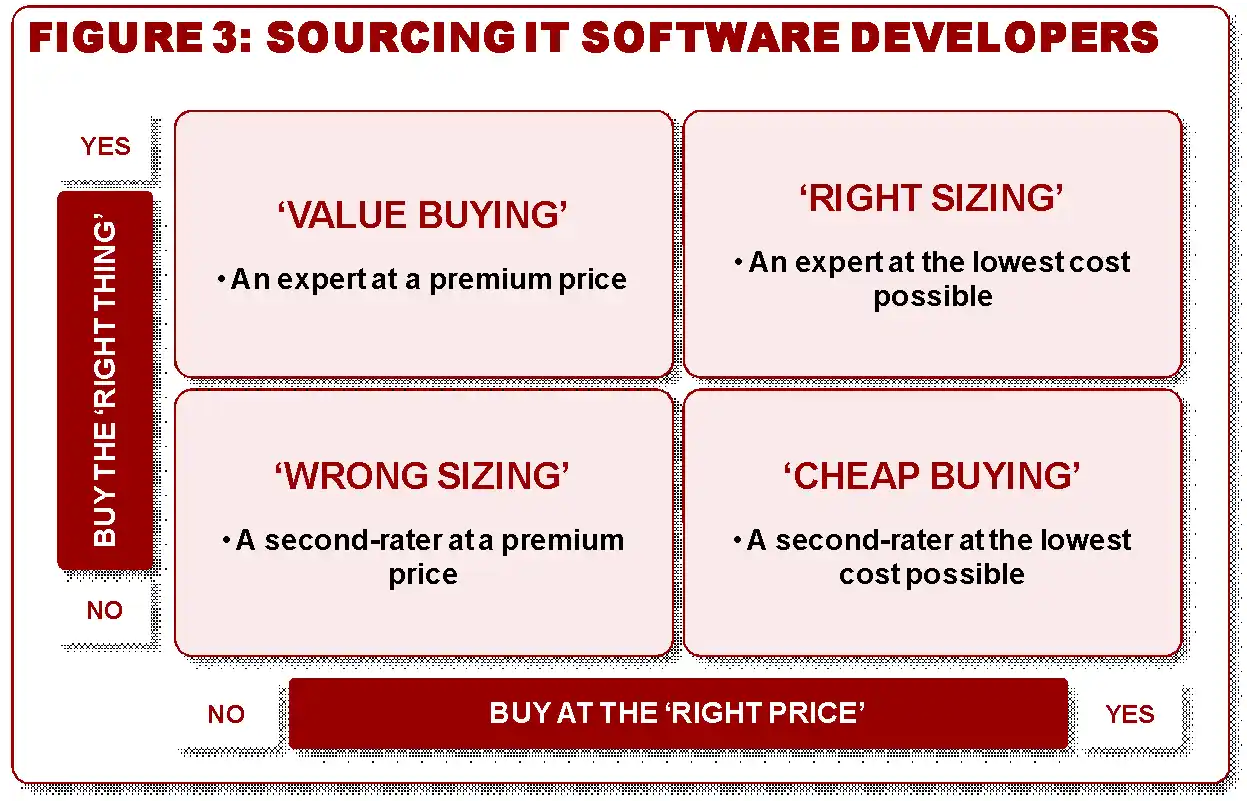
Figure 3: Sourcing IT software developers
A two-by-two matrix. The vertical axis is ‘Buy the ‘right thing’’, with Yes at the top and No at the bottom. The horizontal axis is ‘Buy at the ‘right price’’, with No on the left and Yes on the right.
- Top left, ‘Value Buying’: An expert at a premium price
- Top right, ‘Right Sizing’: An expert at the lowest cost possible
- Bottom left, ‘Wrong Sizing’: A second-rater at a premium price
- Bottom right, ‘Cheap Buying’: A second-rater at the lowest cost possible
As Figure 3 demonstrates if the focus of sourcing is based solely on cost reduction then there is always likely to be a desire to undertake Cheap Buying (i.e. aggregating all requirements for developers into a number of preferred suppers who may only be able to provide second-rate developers given the low day rates that cost leveraged sourcing strategies normally generate). As a result, in practice customers using framework agreements normally end up receiving the ‘Wrong Stuff’, but at a low price (i.e. a cheap person) rather than the ‘Right Stuff’ (i.e. the right person at either a premium price or, ideally, at a keen rate).
In the case of IT software developers the ‘value for money’ trade-offs that buyers need to debate with their customers are, therefore, whether it is better to undertake Right Sizing (i.e. having a much more productive developer, at the lowest possible cost); Value Buying (i.e. having a much more productive developer, but at a premium price); Cheap Buying (i.e. a second-rater at the lowest possible cost) or, Wrong Sizing ( i.e. having a second-rater, but at a premium price).
The problem for orthodox procurement practices is that the focus on cost-down savings tends to force them into Cheap Buying at the expense of the increased productivity that comes from sourcing expert developers, which is normally a much better ‘value for money’ trade-off. This is because having the right person is normally better than having a cheap person for this supply requirement, not least because of the high incidence of time and cost overruns from sub-standard software development.
Unfortunately, when trying to source expert developers at a keen price the use of long-term framework agreements is once again not normally very effective. This is because expert developers are in high demand and they know they can command a premium price. As a result, they are unlikely to work for buyers who can only offer them low day rates. Given that they normally have many options, the sourcing of expert developers may best be achieved using the latest available on-line catalogue technology (like the G-Cloud approach discussed below). This technology allows individuals or smaller niche suppliers to bid whenever they become available for work, and this can sometimes provide a much more effective mechanism for obtaining keen pricing in the short-term.
These two short examples demonstrate that current orthodox aggregation and leverage approaches to procurement may be delivering low value supply (i.e. the ‘Wrong Stuff’ rather than the ‘Right Stuff’). This would not be so bad if it always delivered Cheap Buying, but it may very well be that it is also providing Wrong Sizing (i.e. delivering the ‘Wrong Stuff’ and at the ‘Wrong Price’).
Below we demonstrate how a recent innovation in sourcing leverage, associated with the adoption of on-line catalogue technology, has demonstrated superior capability in reducing costs (while also providing increased functionality to customers), compared with current orthodox aggregation and volume leverage approaches.
3. G-Cloud — Improving Value & Reducing Costs Through On-Line Technology Innovation
There is often a lack of clarity in public procurement because of the development of contradictory policies being pursed by different parts of the public sector. We saw above that in 2013 CCS decided to pursue an aggregation and volume leverage approach for the whole of the public sector. Unfortunately, this policy decision was taken even though the government had previously announced a very different approach for public sourcing in relation to SMEs.
In a 2011 David Cameron made the following quotes or statement:
“Today, we are announcing big changes to the way government does business.”
“No one should doubt how important this is.”
“It’s important for getting to grips with our deficit, as it will help us tackle waste and control public spending.”
“…the system doesn’t encourage small and medium-sized businesses, charities and social enterprises to compete for contracts…
…the very firms who can provide the competitive pressure to drive down costs.”
“…wherever possible, we’re going to break up large contracts into smaller elements, so that SMEs can make a bid and get involved”
One of the major developments from this initial statement of intent was the creation of an on-line public sector catalogue called Cloud Store in the Home Office in April 2012. This was created to enable the Home Office to buy from new suppliers more easily than using standard Home Office framework strategies. Since then Cloud Store has gone through six iterations to become The Digital Marketplace (DM), as shown in Figure 4.
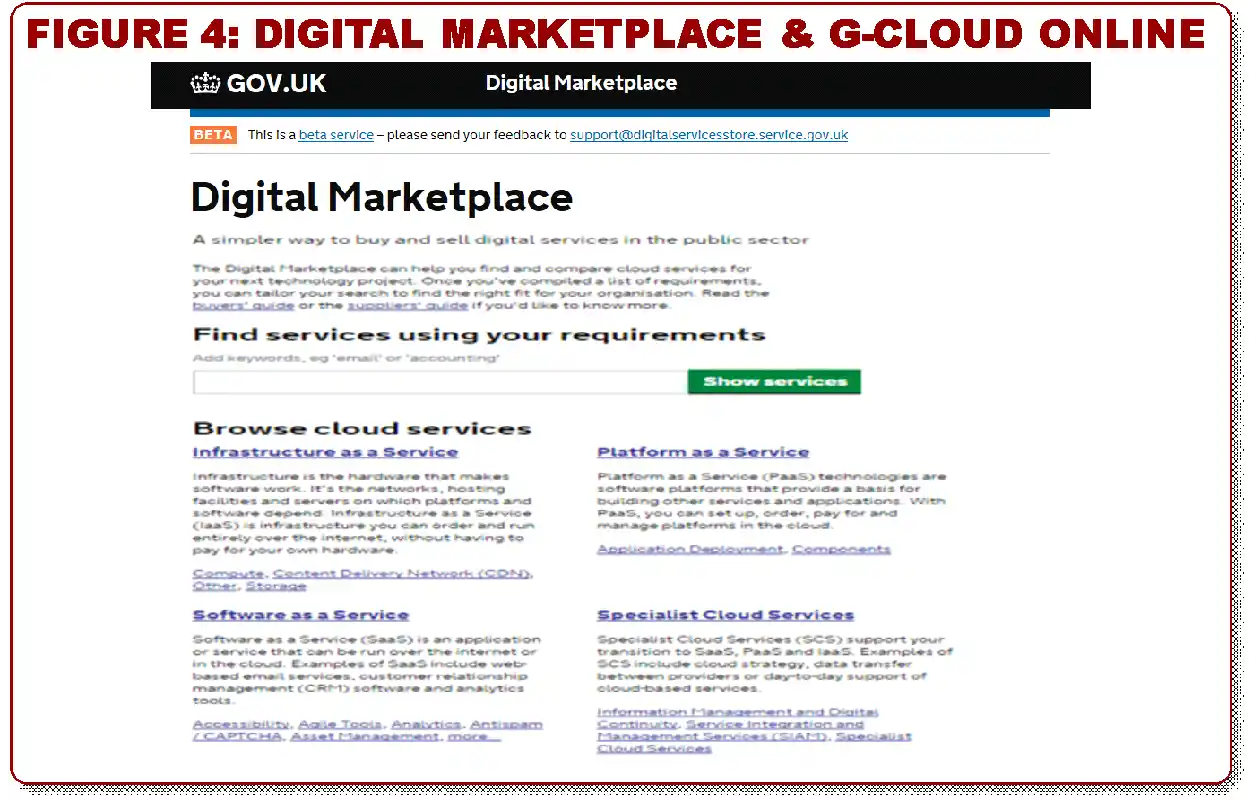
Figure 4: Digital Marketplace & G-Cloud online
A screenshot of the GOV.UK Digital Marketplace home page, marked as a beta service.
Digital Marketplace: a simpler way to buy and sell digital services in the public sector. The Digital Marketplace can help you find and compare cloud services for your next technology project. Once you’ve compiled a list of requirements, you can tailor your search to find the right fit for your organisation. Read the buyers’ guide or the suppliers’ guide if you’d like to know more.
Find services using your requirements: a search box (add keywords, e.g. ‘email’ or ‘accounting’) with a ‘Show services’ button.
Browse cloud services:
- Infrastructure as a Service: infrastructure is the hardware that makes software work. It’s the networks, hosting facilities and servers on which platforms and software depend. Infrastructure as a Service (IaaS) is infrastructure you can order and run entirely over the internet, without having to pay for your own hardware. Categories: Compute, Content Delivery Network (CDN), Other, Storage.
- Platform as a Service: Platform as a Service (PaaS) technologies are software platforms that provide a basis for building other services and applications. With PaaS, you can set up, order, pay for and manage platforms in the cloud. Categories: Application Deployment, Components.
- Software as a Service: Software as a Service (SaaS) is an application or service that can be run over the internet or in the cloud. Examples of SaaS include web-based email services, customer relationship management (CRM) software and analytics tools. Categories: Accessibility, Agile Tools, Analytics, Antispam/CAPTCHA, Asset Management, and more.
- Specialist Cloud Services: Specialist Cloud Services (SCS) support your transition to SaaS, PaaS and IaaS. Examples of SCS include cloud strategy, data transfer between providers or day-to-day support of cloud-based services. Categories: Information Management and Digital Continuity, Service Integration and Management (SIAM), Specialist Cloud Services.
The DM is built in-house by the Government Digital Service in London using open source software components. The DM uses an OJEU framework that is now regularly updated on a six-monthly basis to populate it with G-Cloud suppliers. The commercial construct is that DM is a catalogue of services bought by public sector buyers and that is transparently visible on-line, as shown in Figure 5.
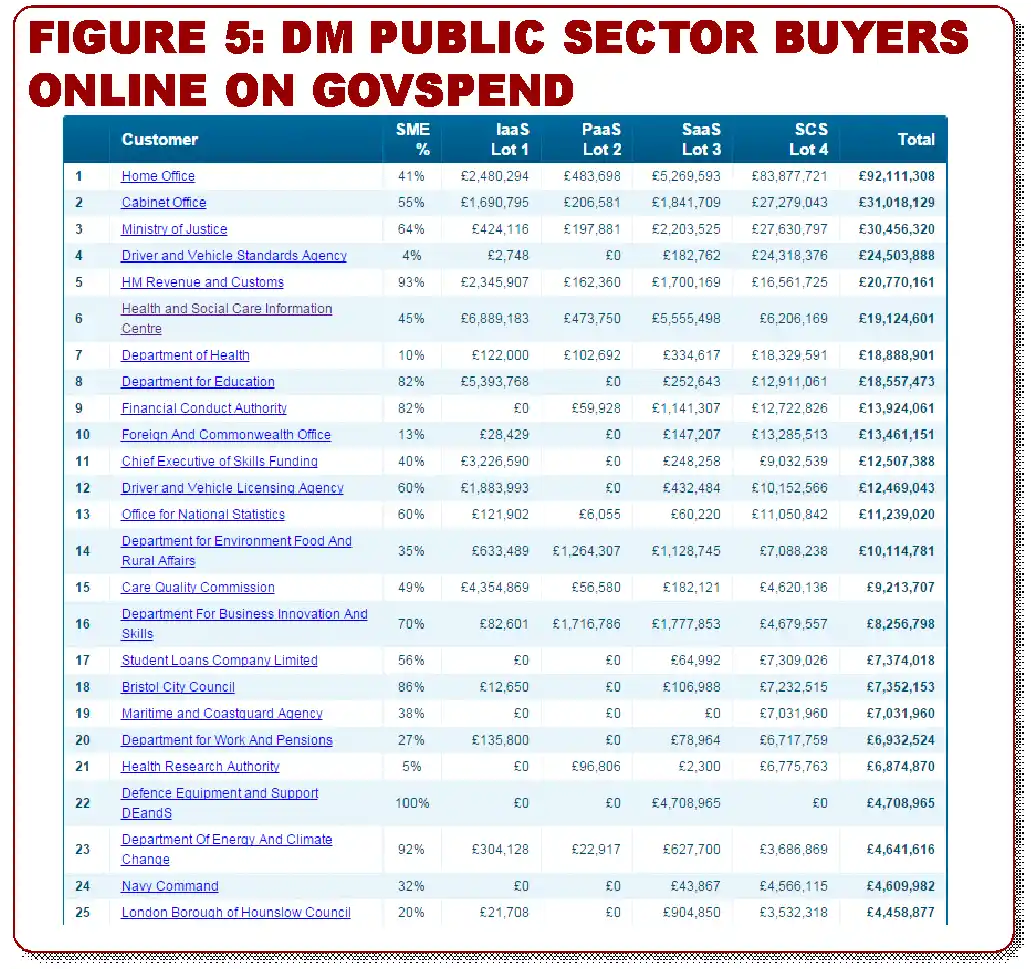
Figure 5: DM public sector buyers online on Govspend
Table of the top 25 public sector buyers on the Digital Marketplace, ranked by total spend, with each buyer’s SME share of spend and its spend in each of the four lots: IaaS (Lot 1), PaaS (Lot 2), SaaS (Lot 3) and SCS (Lot 4).
| Rank | Customer | SME % | IaaS Lot 1 | PaaS Lot 2 | SaaS Lot 3 | SCS Lot 4 | Total |
|---|---|---|---|---|---|---|---|
| 1 | Home Office | 41% | £2,480,294 | £483,698 | £5,269,593 | £83,877,721 | £92,111,308 |
| 2 | Cabinet Office | 55% | £1,690,795 | £206,581 | £1,841,709 | £27,279,043 | £31,018,129 |
| 3 | Ministry of Justice | 64% | £424,116 | £197,881 | £2,203,525 | £27,630,797 | £30,456,320 |
| 4 | Driver and Vehicle Standards Agency | 4% | £2,748 | £0 | £182,762 | £24,318,376 | £24,503,888 |
| 5 | HM Revenue and Customs | 93% | £2,345,907 | £162,360 | £1,700,169 | £16,561,725 | £20,770,161 |
| 6 | Health and Social Care Information Centre | 45% | £6,889,183 | £473,750 | £5,555,498 | £6,206,169 | £19,124,601 |
| 7 | Department of Health | 10% | £122,000 | £102,692 | £334,617 | £18,329,591 | £18,888,901 |
| 8 | Department for Education | 82% | £5,393,768 | £0 | £252,643 | £12,911,061 | £18,557,473 |
| 9 | Financial Conduct Authority | 82% | £0 | £59,928 | £1,141,307 | £12,722,826 | £13,924,061 |
| 10 | Foreign And Commonwealth Office | 13% | £28,429 | £0 | £147,207 | £13,285,513 | £13,461,151 |
| 11 | Chief Executive of Skills Funding | 40% | £3,226,590 | £0 | £248,258 | £9,032,539 | £12,507,388 |
| 12 | Driver and Vehicle Licensing Agency | 60% | £1,883,993 | £0 | £432,484 | £10,152,566 | £12,469,043 |
| 13 | Office for National Statistics | 60% | £121,902 | £6,055 | £60,220 | £11,050,842 | £11,239,020 |
| 14 | Department for Environment Food And Rural Affairs | 35% | £633,489 | £1,264,307 | £1,128,745 | £7,088,238 | £10,114,781 |
| 15 | Care Quality Commission | 49% | £4,354,869 | £56,580 | £182,121 | £4,620,136 | £9,213,707 |
| 16 | Department For Business Innovation And Skills | 70% | £82,601 | £1,716,786 | £1,777,853 | £4,679,557 | £8,256,798 |
| 17 | Student Loans Company Limited | 56% | £0 | £0 | £64,992 | £7,309,026 | £7,374,018 |
| 18 | Bristol City Council | 86% | £12,650 | £0 | £106,988 | £7,232,515 | £7,352,153 |
| 19 | Maritime and Coastguard Agency | 38% | £0 | £0 | £0 | £7,031,960 | £7,031,960 |
| 20 | Department for Work And Pensions | 27% | £135,800 | £0 | £78,964 | £6,717,759 | £6,932,524 |
| 21 | Health Research Authority | 5% | £0 | £96,806 | £2,300 | £6,775,763 | £6,874,870 |
| 22 | Defence Equipment and Support DEandS | 100% | £0 | £0 | £4,708,965 | £0 | £4,708,965 |
| 23 | Department Of Energy And Climate Change | 92% | £304,128 | £22,917 | £627,700 | £3,686,869 | £4,641,616 |
| 24 | Navy Command | 32% | £0 | £0 | £43,867 | £4,566,115 | £4,609,982 |
| 25 | London Borough of Hounslow Council | 20% | £21,708 | £0 | £904,850 | £3,532,318 | £4,458,877 |
Each service line is defined and the price published in the catalogue, with currently some 19,996 services on offer on-line from 1,852 suppliers, as shown in Figure 6. Prices can be lowered in the system, but they cannot be raised. All trades are public (on http://govspend.org.uk/).
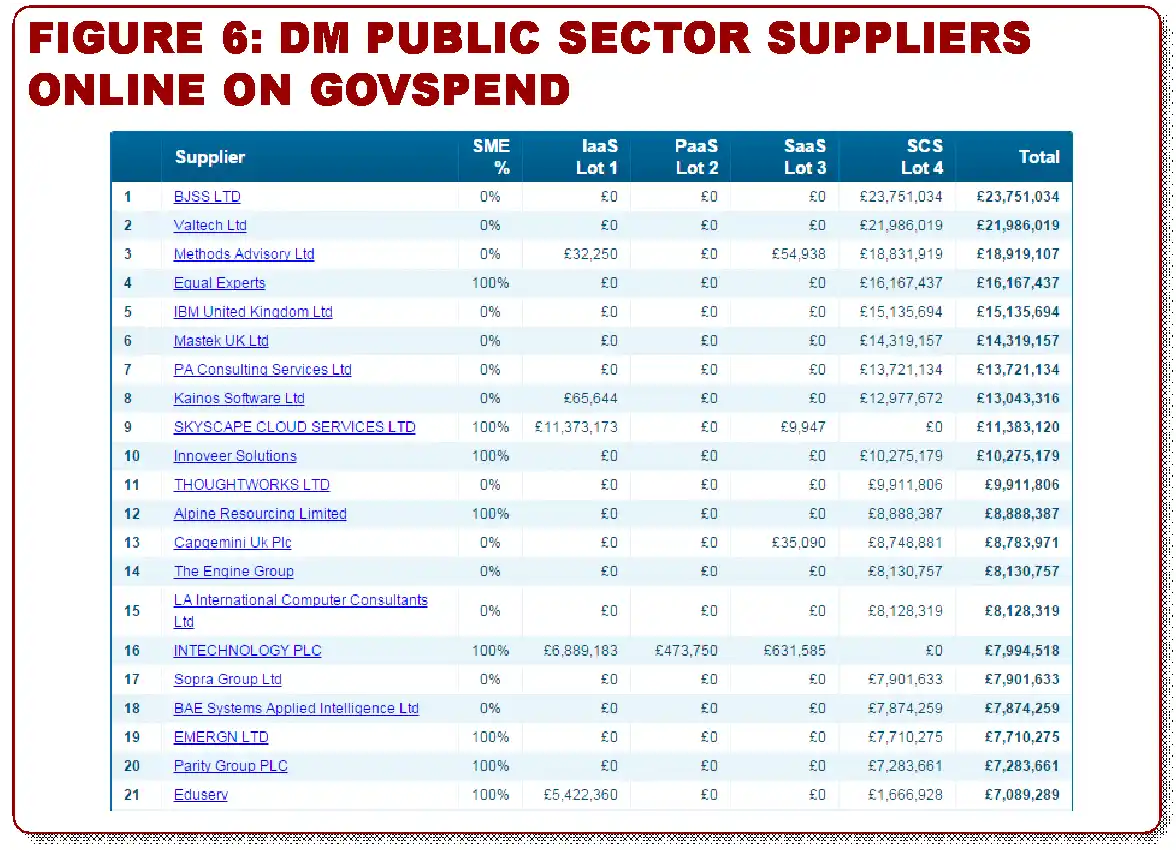
Figure 6: DM public sector suppliers online on Govspend
Table of the top 21 suppliers on the Digital Marketplace, ranked by total sales, with each supplier’s SME status (0% or 100%) and its sales in each of the four lots: IaaS (Lot 1), PaaS (Lot 2), SaaS (Lot 3) and SCS (Lot 4).
| Rank | Supplier | SME % | IaaS Lot 1 | PaaS Lot 2 | SaaS Lot 3 | SCS Lot 4 | Total |
|---|---|---|---|---|---|---|---|
| 1 | BJSS LTD | 0% | £0 | £0 | £0 | £23,751,034 | £23,751,034 |
| 2 | Valtech Ltd | 0% | £0 | £0 | £0 | £21,986,019 | £21,986,019 |
| 3 | Methods Advisory Ltd | 0% | £32,250 | £0 | £54,938 | £18,831,919 | £18,919,107 |
| 4 | Equal Experts | 100% | £0 | £0 | £0 | £16,167,437 | £16,167,437 |
| 5 | IBM United Kingdom Ltd | 0% | £0 | £0 | £0 | £15,135,694 | £15,135,694 |
| 6 | Mastek UK Ltd | 0% | £0 | £0 | £0 | £14,319,157 | £14,319,157 |
| 7 | PA Consulting Services Ltd | 0% | £0 | £0 | £0 | £13,721,134 | £13,721,134 |
| 8 | Kainos Software Ltd | 0% | £65,644 | £0 | £0 | £12,977,672 | £13,043,316 |
| 9 | SKYSCAPE CLOUD SERVICES LTD | 100% | £11,373,173 | £0 | £9,947 | £0 | £11,383,120 |
| 10 | Innoveer Solutions | 100% | £0 | £0 | £0 | £10,275,179 | £10,275,179 |
| 11 | THOUGHTWORKS LTD | 0% | £0 | £0 | £0 | £9,911,806 | £9,911,806 |
| 12 | Alpine Resourcing Limited | 100% | £0 | £0 | £0 | £8,888,387 | £8,888,387 |
| 13 | Capgemini Uk Plc | 0% | £0 | £0 | £35,090 | £8,748,881 | £8,783,971 |
| 14 | The Engine Group | 0% | £0 | £0 | £0 | £8,130,757 | £8,130,757 |
| 15 | LA International Computer Consultants Ltd | 0% | £0 | £0 | £0 | £8,128,319 | £8,128,319 |
| 16 | INTECHNOLOGY PLC | 100% | £6,889,183 | £473,750 | £631,585 | £0 | £7,994,518 |
| 17 | Sopra Group Ltd | 0% | £0 | £0 | £0 | £7,901,633 | £7,901,633 |
| 18 | BAE Systems Applied Intelligence Ltd | 0% | £0 | £0 | £0 | £7,874,259 | £7,874,259 |
| 19 | EMERGN LTD | 100% | £0 | £0 | £0 | £7,710,275 | £7,710,275 |
| 20 | Parity Group PLC | 100% | £0 | £0 | £0 | £7,283,661 | £7,283,661 |
| 21 | Eduserv | 100% | £5,422,360 | £0 | £0 | £1,666,928 | £7,089,289 |
G-Cloud is highly innovative legally, allowing large numbers of suppliers onto a framework and allowing buyers to choose suppliers from information provided (and updated) rather than from using competitions. Currently the G-Cloud focuses on cloud services and related consulting but the concept can and will be extended widely in the UK public sector. To date some 700 buyers have, however, bought from some 500 suppliers and there has recently been an exponential increase in participation amongst public buyers, as shown in Figure 7. The current annual run rate for services being purchased through G-Cloud is now over £0.6b.
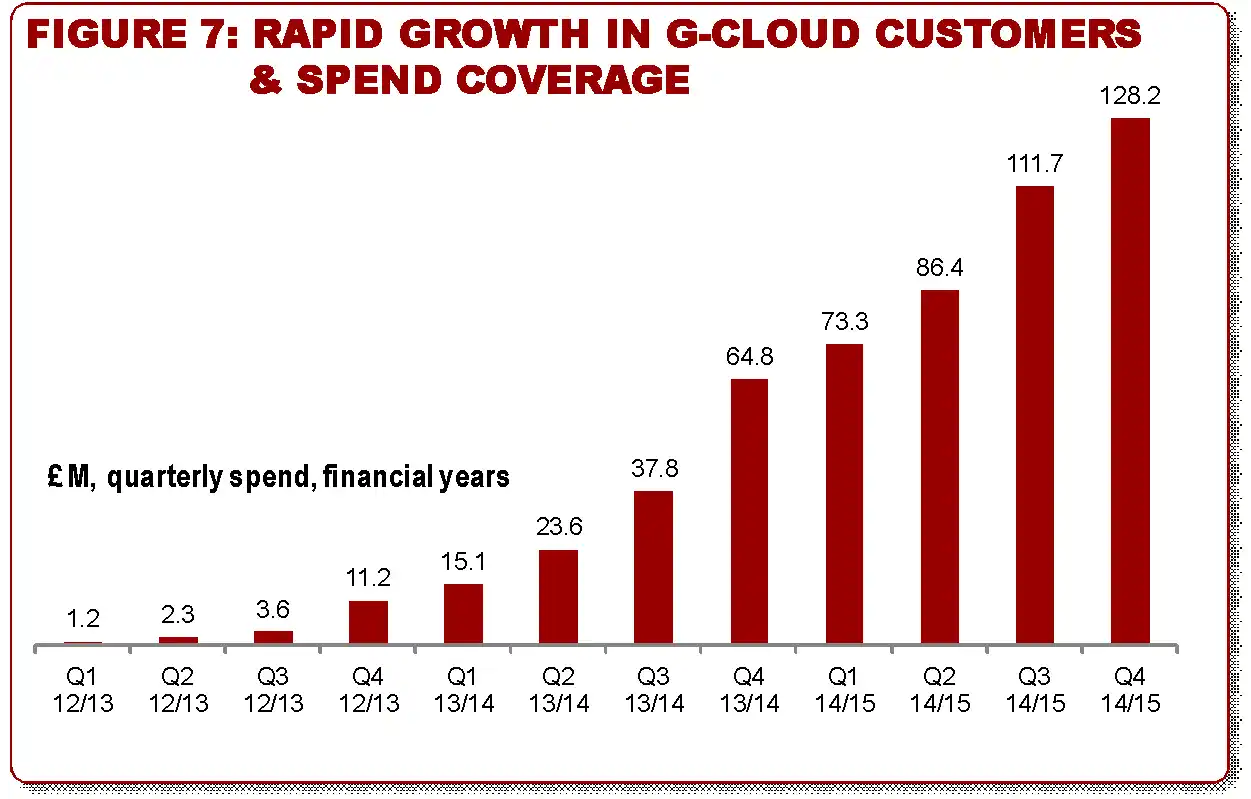
Figure 7: Rapid growth in G-Cloud customers & spend coverage
Bar chart of G-Cloud quarterly spend in £M by financial quarter, rising from £1.2m to £128.2m over three years.
- Q1 12/13: 1.2
- Q2 12/13: 2.3
- Q3 12/13: 3.6
- Q4 12/13: 11.2
- Q1 13/14: 15.1
- Q2 13/14: 23.6
- Q3 13/14: 37.8
- Q4 13/14: 64.8
- Q1 14/15: 73.3
- Q2 14/15: 86.4
- Q3 14/15: 111.7
- Q4 14/15: 128.2
Most importantly than mere usage, however, are the ‘value for money’ benefits that have been delivered by DM and G-Cloud. In pursuit of opening up the public sector to new SME suppliers (as desired initially by the Prime Minister in 2011) so far 50% of sales have been with SMEs, compared with only 10% within normal legacy central Government procurement processes. Perhaps the most important finding from this exercise in on-line bidding is that G-Cloud has reduced transaction costs for buyers and sellers and provided an easy way for public bodies to buy within days rather than months. Many of the revolutionary process benefits from the use of this new on-line process are identified in Figure 8.
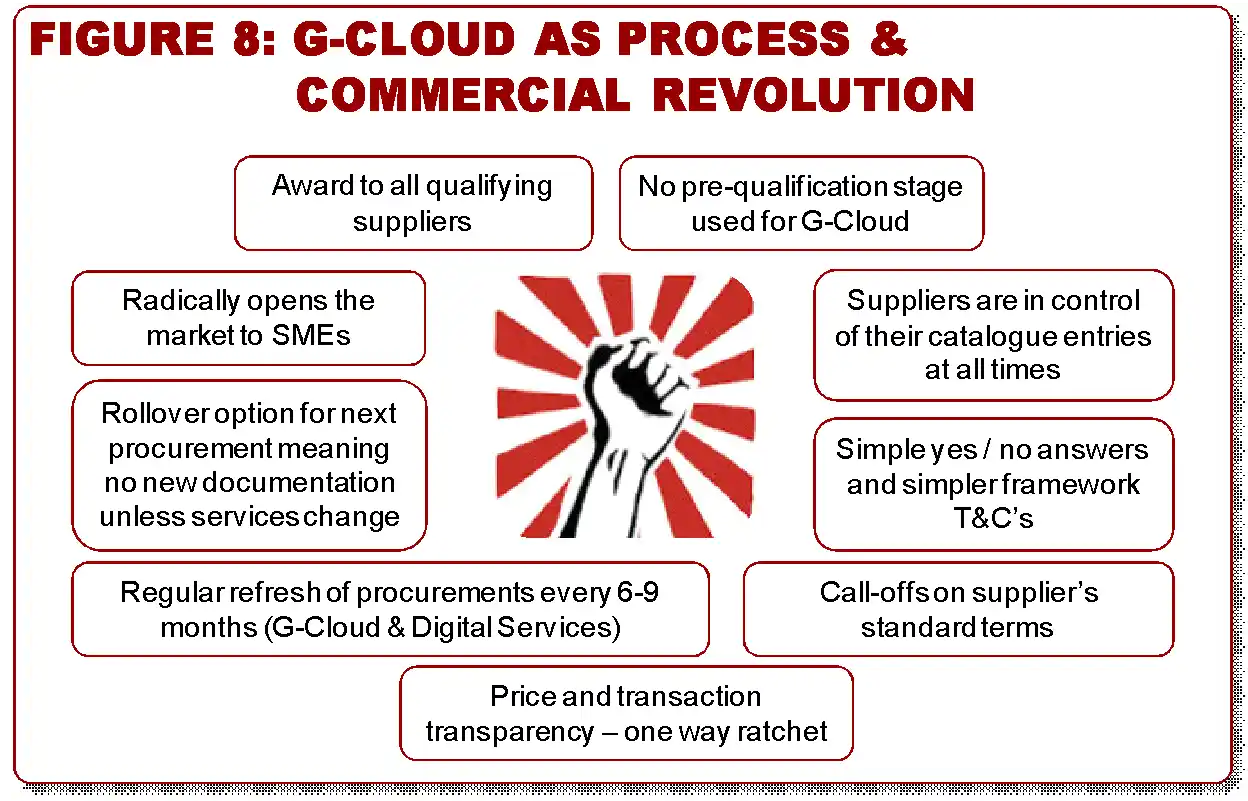
Figure 8: G-Cloud as process & commercial revolution
A clenched fist symbol, surrounded by nine boxes describing the G-Cloud process and commercial benefits:
- Award to all qualifying suppliers
- No pre-qualification stage used for G-Cloud
- Radically opens the market to SMEs
- Suppliers are in control of their catalogue entries at all times
- Rollover option for next procurement meaning no new documentation unless services change
- Simple yes/no answers and simpler framework T&C’s
- Regular refresh of procurements every 6-9 months (G-Cloud & Digital Services)
- Call-offs on supplier’s standard terms
- Price and transaction transparency — one way ratchet
Furthermore, the process is compliant by default and matches buyers with best ‘value for money’ suppliers with zero friction, and without time-consuming attempts to force through standardisation and aggregation or complex market testing activities to identify preferred suppliers. This has generated a high degree of customer and supplier satisfaction.
Most importantly of all, research shows that typical cost savings are in the order of 50% when compared with legacy and/or aggregation and framework-based leverage strategies. Examples below confirm the radical improvement in costs from this iterative and multiple supplier on-line bidding process:
- Some Departments were paying £57 for IT power cables that could be bought on-line for £20 individually, and £8 wholesale — a potential saving of between 65% and 86%
- In 2015, a Department reduced their cost of web-hosting by 90% using G-Cloud
- An SME bid using digital was 87% less than the incumbent central Government centralised supplier
- Managed email services on G-Cloud is less than half the price of current CCS managed email framework pricing
- DFE received a total service cost for educational services that was 40% cheaper than any other bids
- Employment Tribunals received a digital payment service 25% cheaper than any other bids, and it was delivered a year earlier than originally planned
- MOJ saved 1.1M per Megawatt energy/year and 6000 tons of carbon against industry average from bidding on Data Centre hardware containers
- DVLA saved 75% on the original business case estimates for an Enquiry Platform SME cluster
The evidence so far shows that G-Cloud provides a considerable number of benefits over orthodox aggregation and volume leverage approaches. These include the following:
- “Red Tape Buster”: reduces procurement time from 227 days (2010) to a typical 2 to 4 weeks (and fastest in 3 minutes). Delivers procurement reform (faster, simpler access to best VFM).
- Increases Government spend with SMEs directly and substantially. 90% of SMEs benefitting are UK-based. SMEs have created 60% of jobs since 2010.
- Saves money for the taxpayer: G Cloud saves 50% of spend on average.
- Elegant use of EU regulations: Systems Up CEO: “G Cloud is transformational”.
- Helps economic growth and exports of technology.
- Is a British first: world leading design visible to citizens.
- Uses transparency, competition and digital to deliver results.
The future opportunities for improvement are of course immense and, as Figure 9 shows G-Cloud has only just started to impact upon UK public sector sourcing and supply management since its inception in 2012 in the Home Office.
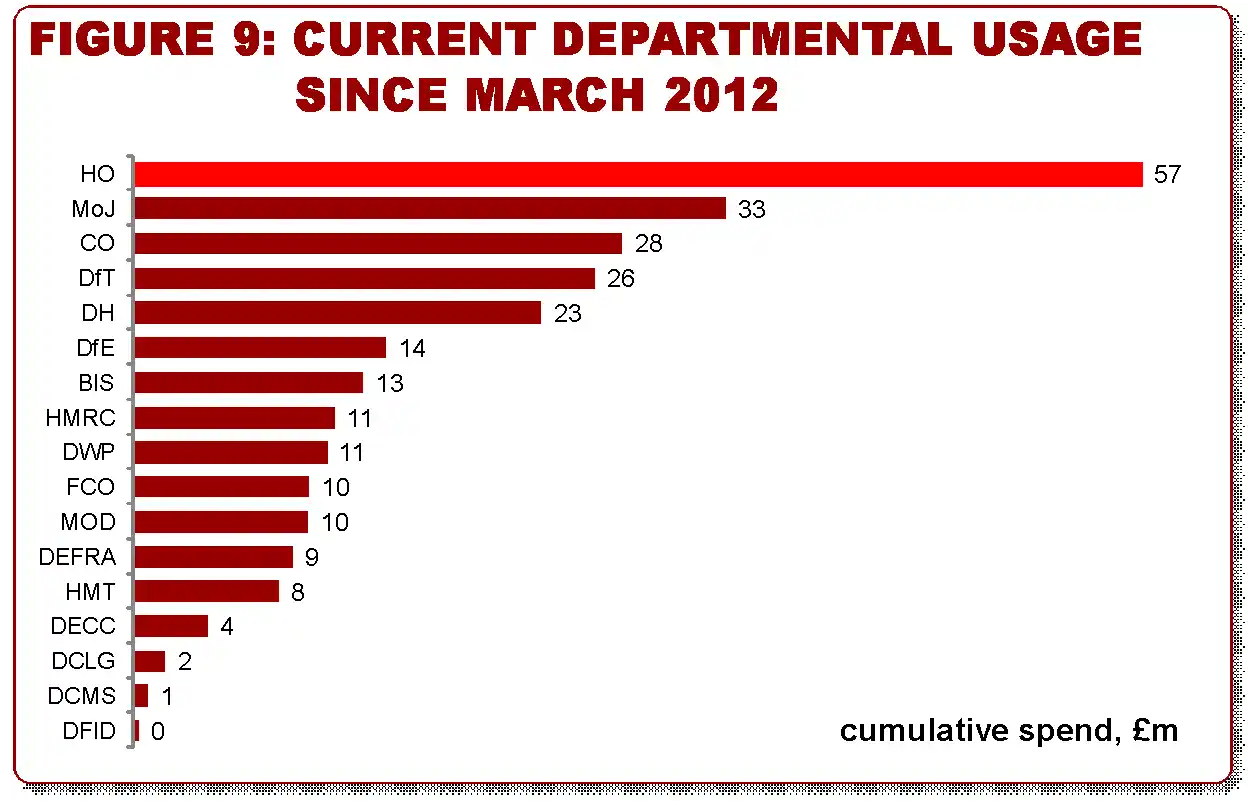
Figure 9: Current departmental usage since March 2012
Horizontal bar chart of cumulative G-Cloud spend by department, in £m, with the Home Office highlighted.
- HO: 57
- MoJ: 33
- CO: 28
- DfT: 26
- DH: 23
- DfE: 14
- BIS: 13
- HMRC: 11
- DWP: 11
- FCO: 10
- MOD: 10
- DEFRA: 9
- HMT: 8
- DECC: 4
- DCLG: 2
- DCMS: 1
- DFID: 0
Given its current growing success in other Departments the forward strategy for G-Cloud is, as indicated in Figure 10, to expand widely into the public sector.
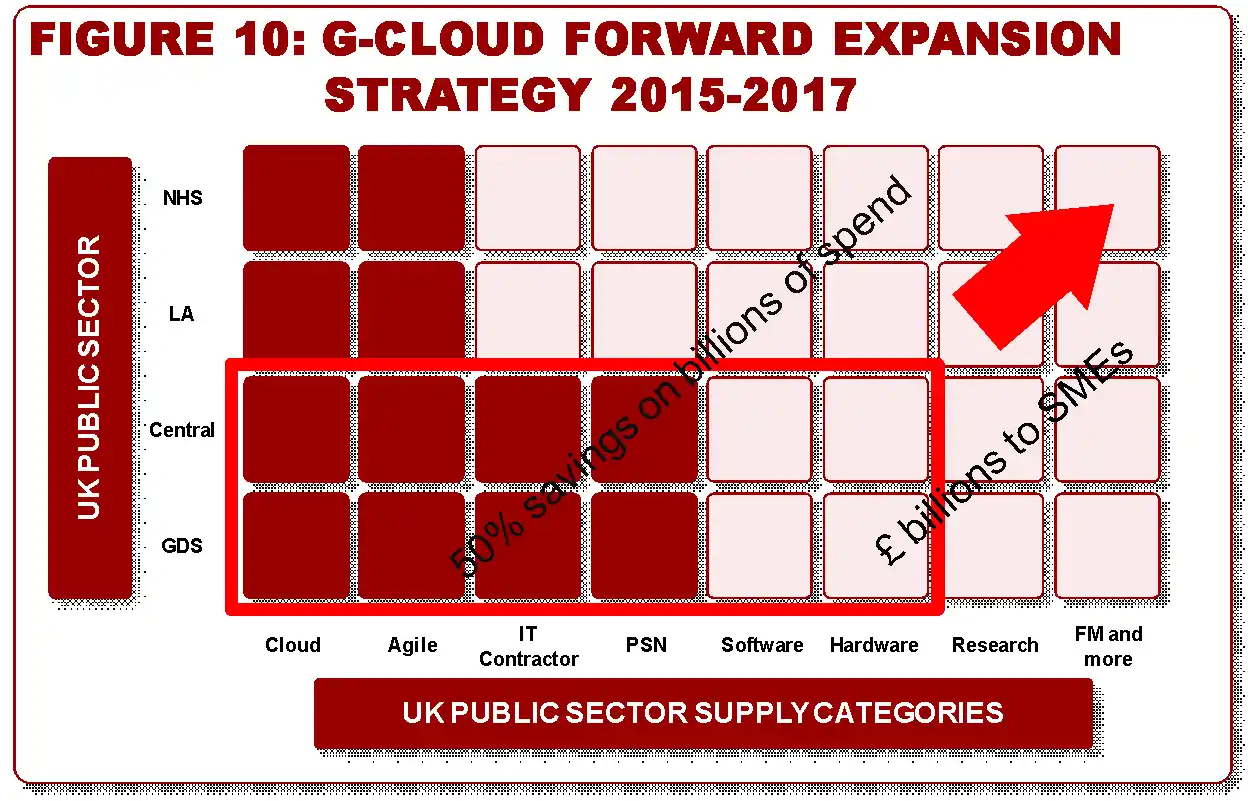
Figure 10: G-Cloud forward expansion strategy 2015-2017
A grid. The vertical axis is ‘UK public sector’, with four rows: NHS, LA (local authorities), Central and GDS. The horizontal axis is ‘UK public sector supply categories’, with eight columns: Cloud, Agile, IT Contractor, PSN, Software, Hardware, Research, and FM and more.
- Already covered (shaded dark): Cloud and Agile across all four rows, and IT Contractor and PSN in the Central and GDS rows.
- Not yet covered (shaded light): all other cells, including all of Software, Hardware, Research, and FM and more.
- A red outline marks the Central and GDS rows across Cloud, Agile, IT Contractor, PSN, Software and Hardware, labelled ‘50% savings on billions of spend’ and ‘£ billions to SMEs’.
- A large red arrow points towards the top right (NHS and LA with the later supply categories), showing the direction of expansion.
The current forward implementation strategy is as follows:
-
Extend functionality from a public catalogue to full self-service platform:
- One stop shop for digital project components
- Click for reference customers and their contact details
- Auto-document the award decision. “Compliant by default”
- One click purchase full integration to purchase to pay and ERP systems
- Detailed feedback to losers who can the improve their offering
- Geographic and SME search capability
-
Achieve category range authority (it stocks all you need) through proactive best-of-breed management of suppliers, who can join and leave the G Cloud dynamically.
-
Extend customer base from Central Government to Local Authorities (LAs), Health and WPS. Contracting authorities can let their own frameworks. G-Cloud provides the front-end.
-
Extend product categories as far as appropriate (strong interest from PSN, IT contractors, IT software and hardware, FM, Construction, Health, MOD Research Cloud, Home Office ESCMP and more).
-
Support export opportunities for “Best of British” suppliers.
Given this success does this mean that the traditional procurement approach of CCS based primarily on aggregation thinking is now completely outdated for the public sector? The simple answer is no. But what the G-Cloud revolution (and similar developments in Digital Marketplaces) is showing is that traditional thinking about best practice in procurement and sourcing needs to be significantly modified.
4. From Tactical Spend Management to Value Flow Management — What Next to Improve Public Sector Sourcing?
This analysis shows that relying solely on aggregation and volume leverage is unlikely to be the most effective strategy for all public buying in the future, although it can be a most effective strategy in certain power and leverage circumstances, as historic CCS frameworks have shown when applied in appropriate areas. This is normally in Buyer Dominance (Leverage) power positions, when there are standardised requirements, and the award of high and regular volumes to one, or only a few, suppliers, enables them to use economies of scale/scope to produce lower unit costs, that can be passed on to the buyer.
As the case examples above demonstrate, for goods and/or services where there are no or few cost benefits from more effective physical capacity utilisation aggregation and volume leverage is not always the most appropriate sourcing strategy. As a result, the primary issue that has to be addressed by public sector buyers (as it is for private sector buyers) is what is the most appropriate sourcing strategy to pursue given a particular power circumstance?
Obviously, while we expect to see how widely iterative, on-line decremental bidding can be used within the whole of the UK public sector using the DM and G-Cloud approach, it is already clear that this is not likely to be the most appropriate sourcing approach for all public sector sourcing. Where there are power scenarios of Dependency and Alliance, with few dynamic levers to move power positions into more congenial leverage positions (such as Market or Leverage) it is inevitable that on-line bidding strategies are unlikely to be viable and more collaborative ways of working will be required (see the discussion on the appropriateness of collaborative approaches in Cox (2014).
Given this it is to be hoped that public sector buyers will begin to adopt the Power Positioning and Sourcing Portfolio Analysis techniques that provide a more sophisticated understanding of the range of sourcing options available for buyers under different power scenarios. On top of this it will be essential for the public sector to address in the future the major problem with current procurement practice, and one that is also evident in the private sector. This is the continuing attachment to Tactical Spend Management rather than Strategic Value Flow Management thinking.
It will come as no surprise that IIAPS believes that most of the organisations seeking assistance with competence development in Procurement and Supply Management are currently locked into Tactical Spend Management approaches. In our view this can only result in sub-optimal ways of thinking, with sub-optimal ways of developing competence.
IIAPS established its PSCM Index (organisational/process) and ICA Index (individual competence) benchmarking tools in 2010 to address this problem. The idea then was that, if CPOs and Commercial Directors understood where their organisation and staff are in relation to world-class best practice, this would provide them with the ability to begin their transformation journey.
The transformation journey requires the rejection of a focus on ‘categories of spend’ in favour of a focus on ‘categories of supply’. This thinking also requires the creation of a cross-functional category management and strategic sourcing process that focuses on ‘strategic, value for money trade-offs’, not just ‘tactical, cost savings’ as the basis of engagement with the organisation.
Unfortunately current thinking within public sector sourcing still appears to be primarily focused — as it is in the private sector — on Tactical Spend Management rather than Strategic Value Flow Management thinking. If this is so then it would appear that current public procurement practice needs considerable Right Sizing. In our view this can only be achieved effectively if Power Positioning and Sourcing Portfolio Analysis techniques are adopted.
References
Cox, Andrew, Sourcing Portfolio Analysis: Power Positioning Tools for Category Management & Strategic Sourcing (Earlsgate Press, 2014).
Cox, Andrew & Ireland, Paul, Value Sourcing: From Spend Management to Supply Management (Earlsgate Press, 2015).
Cox, Andrew & Ireland, Paul, Value Flow Management: How to Create and Appropriate Value from KPI-Driven Companies and Supply Chains (Earlsgate Press, 2015 forthcoming).
Kraljic, Peter, ‘Purchasing must become supply management’, Harvard Business Review (October, 1983).
Porter, Michael, Competitive Strategy (Free Press, 1980).
About the Authors
Stephen Allott is Hon. Member of the University of Cambridge Department of Computer Science, Chairman of Tarigo Ltd. Product Management Training, sometime Crown Representative for Small & Medium Size Enterprises, Cabinet Office, and sometime G-Cloud Digital Marketplace Business Development in the Cabinet Office.
Andrew Cox is Vice President of the International Institute for Advanced Purchasing & Supply, where he is also a Fellow & Black Belt Member.
He is a Visiting Professor at a number of Universities worldwide, including: the Supply Chain Management Institute at the University of San Diego in the USA; and, the Nyenrode Business School in the Netherlands.
He is also a Fellow of the Chartered Institute of Purchasing & Supply in the UK; Holder of the Swinbank Medal for Outstanding Services to Purchasing and Supply; and, a Fellow of the Royal Society of Arts, Commerce and Manufacture.
Professor Cox is also Chairman of IIAPS Services a specialist purchasing and supply chain management consultancy. He has worked with many public and private sector organisations around the world