From Science to Growth
In the Hughes Hall City Lecture 2006, I asked, “What exactly are the mechanisms by which scientific research turns into economic growth?”
One needs to understand these mechanisms to be able to accelerate them.
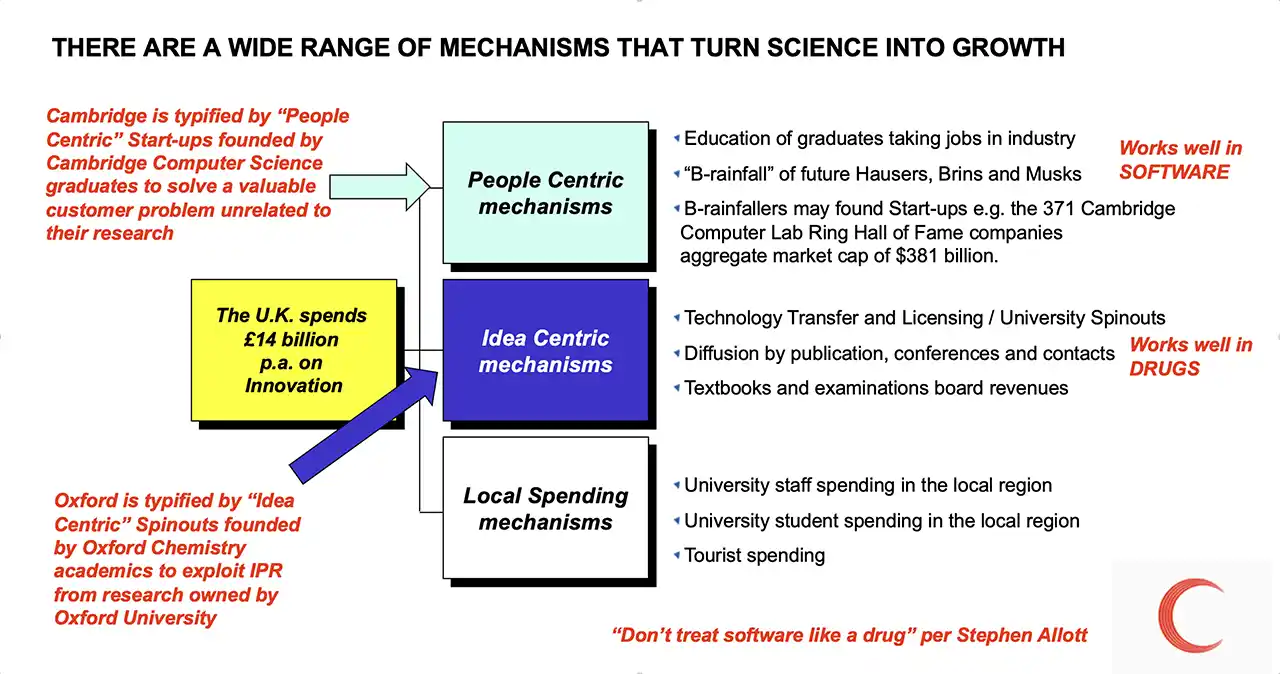
The Treasury had explained that research produces scientists as well as science. As they invent things they also become trained.
Treasury science and innovation report
July 2004
“Studies show that R&D delivers benefits by allowing an economy to do two things:
- understand and appreciate the value of others’ findings and results;
- and make new discoveries.”
The economic case for investment in scence and research, part of the Treasury’s Science & innovation investment framework 2004–2014, page 150
The first of these means looking things up (scientists). The second means inventing things (science).
I have campaigned for 25 years to get the UK to get the full economic impact from its science. We should seek the maximum ROI from its huge spend on acceleration and using the full range of tools to do so.
I failed to win the argument over that 25 years.
But we had a trick up our sleeve. We did the Ring anyway. I kept the Ring in stealth mode.
The $299 billion valuation speaks for itself.
Now that the Ring companies are worth $299 billion with no subsidy, we are waiting for the Idea Centric zealots to explain themselves.
See From Science To Growth 2.0 — an update in 2026 (PDF)
Why the Cambridge Computer Lab Ring matters and what it really tells us (2026) with David Cleevely
The Hickson “Review” — the University IPR Spinout Policy End Game?
Cambridge Computer Lab Ring data read at 27 Aug 2026 23:26.